









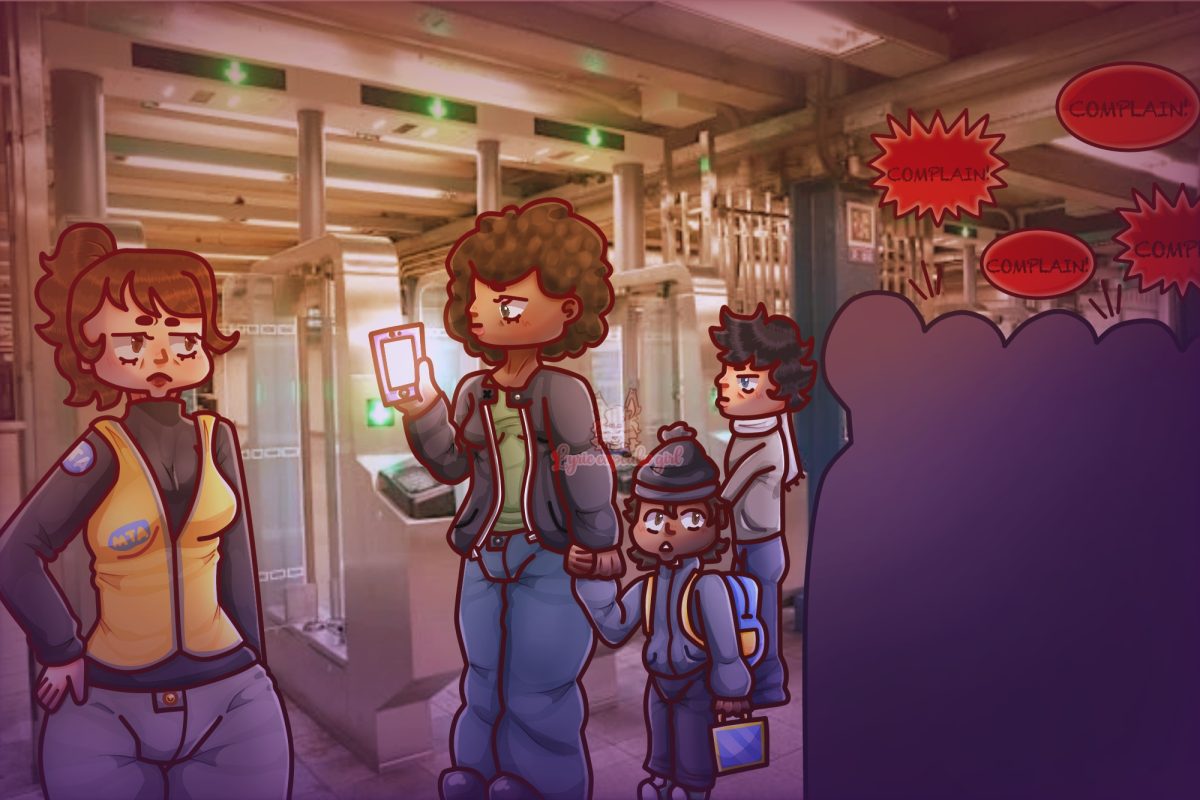











Have you ever been to the station at Broadway and Lafayette Street in Manhattan? As I once was on my way to Soho, I hopped on the 6 train at Parkchester. Everything seems fine, not much of a problem getting through the normal turnstile. As I get to my stop, I see the station full of people, like I’ve never seen it before. As I walk through the station to exit, I see a major crowd surrounding the turnstile. But there’s no turnstile at all; instead, there are new fare gates emitting loud beeps and enforcement agents trying to control the crowd. MTA added these faregates to avoid people who jump the turnstile and to reduce the amount of fare evasion. But is this worth the costs, the chaos and the noise? Building barriers to public transit and creating new enforcement systems is oppressive and inefficient.
At Broadway and Lafayette, new fare gates have created chaos. The station has to be staffed by extra MTA employees just to regulate who can go through, and the criteria for who can ride for free, based on height, makes no sense, as riders have pointed out. Why is it that your height has to be determined by a machine to find out if you can ride for free or not? If MTA was trying to make fare gates something to be truly fair for those who always pay and those who don’t pay then why is a machine making things where depending on your height you can pass with no pay. And height is something no one has any control over. A prime example is what if your kid is very young and already passed 40 inches tall, are you going to make a kid pay because all of a sudden he is healthy and grown? It makes absolutely no sense, which isn’t fair at all.
In addition to faregates being expensive, they are also dangerous. A child’s head got stuck in between the doors and she got rushed to the hospital. The gates have already been installed at the Broadway-Lafayette station, where a child got stuck in a fare gate around 1 p.m., according to the FDNY. The child’s mother told PIX11 News her 5-year-old daughter’s head got stuck between the doors of the fare gate, and a bystander helped get the young girl out. She was taken to the hospital with head swelling, her mother said. Some will put the blame on the parent, but how can we blame a parent for some kind of machine that MTA put in place?
A common argument in favor of installing new faregates is that they reduce fare evasion and help the MTA recover lost revenue. The agency estimates that it loses about $900 million each year to people avoiding fares, which supporters often present as proof that stricter enforcement is necessary.
However, this argument breaks down for two reasons. One, treating fare evasion as a loss of revenue is inaccurate. The cost of running a train line does not fluctuate based on fare revenue. When someone doesn’t pay their fare, they take a free ride, but they are not literally taking money out of the pockets of the MTA.
Second, this argument overlooks the broader financial picture. The MTA operates on a budget of roughly $20 billion, meaning that the reported losses from fare evasion account for less than half of one percent of its total funding. That is a miniscule amount. It doesn’t make sense to spend money and energy to fix something that doesn’t need fixing.
Additionally, fares make up only about 26% of the MTA’s revenue. The majority of its funding actually comes from taxes (around 55%), along with tolls and other smaller sources such as advertising. Because taxpayers provide most of the MTA’s funding, investing large amounts of money into new faregates and expanded enforcement is a terrible decision.
As a taxpayer, it drives me crazy to see the MTA spend money like they don’t care about the people actually using their system. Every dollar we pay in taxes is supposed to make life easier, safer, and better for everyone, but instead we get gates that barely work, unsafe stations, and no thought for families or anyone with a stroller or wheelchair. I want my money to go toward improvements that actually help the community—safer streets, family-friendly transit, and stations that aren’t a pain to navigate. But this won’t happen if we accept the story that fare evasion is ruining the MTA. Making public transportation free is not a crazy proposal; it’s the least the MTA can do. If you also want your tax money to go towards transporting you, not policing you, then make your voice heard.